
Stack
Proof metrics
Problem
Barcode and RFID work looks simple from the outside, but production rules, symbologies, and printer constraints trip up generic code generators.
Teams building AI-assisted logistics products need repeatable primitives instead of one-off prompts.
Solution
Shipped a focused toolkit with utilities and patterns tuned for common enterprise labeling scenarios.
Structured the project so Claude Code can compose solutions without rediscovering AIDC edge cases each time.
Technical deep-dive
Domain-correct defaults for agent-assisted AIDC
Generic LLM code generators routinely miss symbology rules, quiet zones, printer DPI constraints, and GS1 check-digit validation. The toolkit encodes these as reusable primitives so Claude Code and similar agents compose labeling solutions without rediscovering edge cases.
This is the kind of domain glue that separates production logistics AI from demo barcode generators.
Architecture
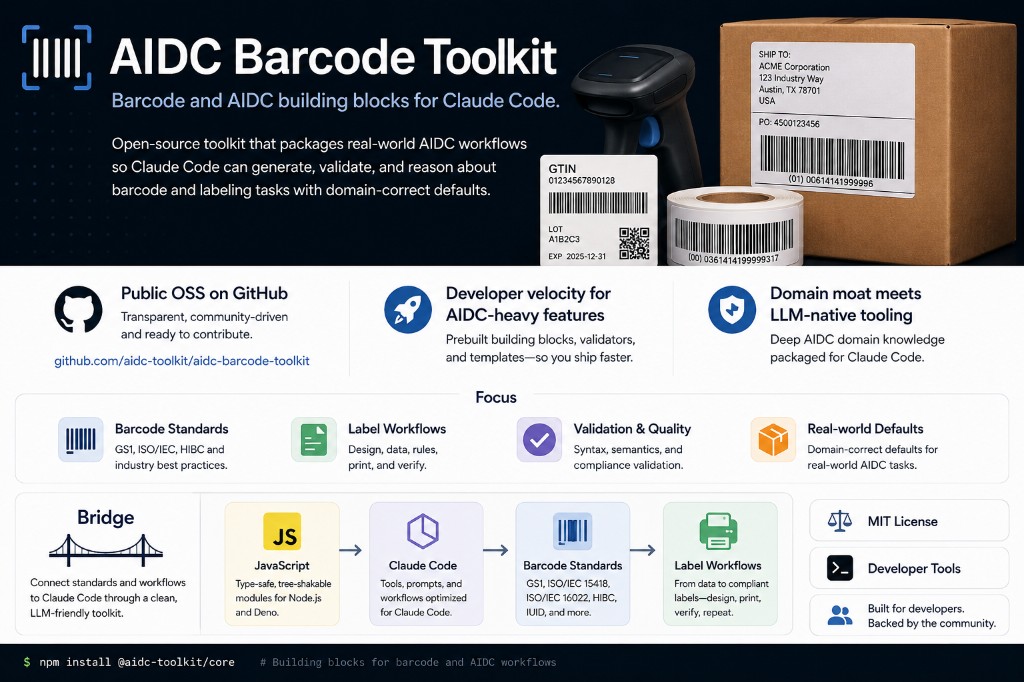
Modular JavaScript utilities with clear boundaries for generation, validation, and workflow helpers.
Documentation-oriented layout optimized for agent-assisted development in Claude Code.
Outcomes
Demonstrates OSS leadership at the intersection of AIDC domain depth and AI engineering.
Creates a reusable bridge between warehouse reality and LLM-powered product delivery.
Links & artifacts
Related work
WaybillAgent
WaybillAgent transforms warehouse auditing from a multi-day manual process into an AI-assisted guided walk using phone capture and agentic reconciliation—flagship build for the Built with Opus 4.7 hackathon hosted by Cerebral Valley and Anthropic (selected top ~500 of 13,000+ applicants).
Read case studySoko ERP
Soko is a production multi-tenant ERP for East African SMBs — now live with 500+ businesses, 2.1M+ transactions, and 99.9% uptime. One platform for POS, multi-location inventory, HR/payroll, accounts, and reporting, with M-Pesa, offline-first sync, and multi-currency support (KES/UGX/TZS).
Read case studyDiscuss this work
Hiring or building something similar—reach out with context and constraints.
Email Joseph